
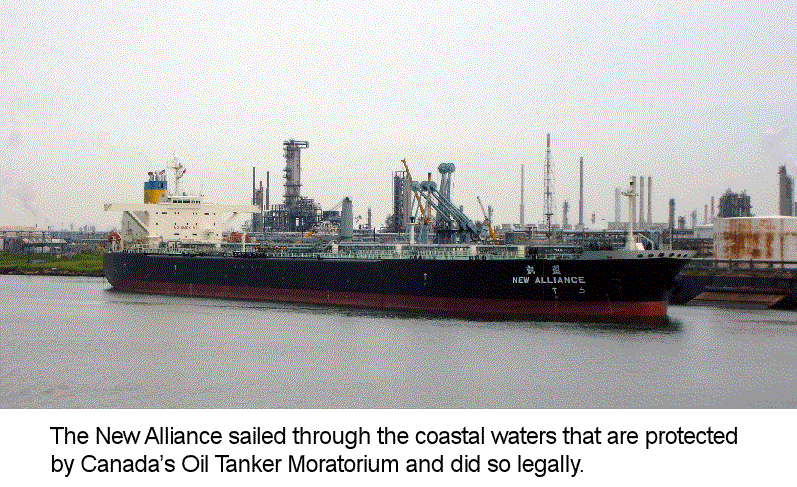
A crude oil tanker sailed between Haida Gwaii and the mainland in ‘Canada’s Oil Tanker Moratorium’ and did so legally.
Thanks to The Globe and Mail, below are quotes from that article. The full article can be found here.
“After loading at Trans Mountain’s Westridge Terminal in Burnaby, the crude oil tanker New Alliance departed for the port of Ningbo-Zhoushan, China on Jan. 7, 2025. Instead of heading directly across the Pacific, however, it went north along British Columbia’s coast, threading between Haida Gwaii and the mainland before turning west to the open Pacific.
This path runs through the coastal waters that are protected by Canada’s Oil Tanker Moratorium Act, but the vessel loaded with up to 550,000 barrels of crude oil from Alberta, broke no law.”
The oil tanker moratorium is not, as the name implies, a tanker ban. It prevents large oil tankers from loading or unloading at the two deep-water ports on B.C.’s north coast – Kitimat and Prince Rupert. Passed into law in 2019, it established a barrier to building a pipeline to either port for Alberta oil, by prohibiting tankers with more than 12,500 tonnes of crude or other heavy oil as cargo from stopping, loading, or unloading at ports or marine installations in the north coast region. It covers an area from the northern tip of Vancouver Island to the southern tip of Alaska.
“The waters covered by the moratorium – Queen Charlotte Sound, Hecate Strait and Dixon Entrance – are often treacherous, especially during the winter storm season. The Liberal government enacted the moratorium following a 2015 election promise to protect the coast from the risk of a catastrophic oil spill.”
“When the New Alliance departed the Westridge terminal with its load of Alberta crude in early January, 2025, a strong southerly gale was blowing in Hecate Strait, with winds gusting up to 100 kph – typical winter weather for that body of water. Marine experts say the conditions would have been worse out in the open Pacific for the captain to take the longer route hugging the west coast.”
Data provided by Transport Canada show the New Alliance made at least two passes through the moratorium waters in 2025, with a second trip in February. That same year, multiple crude oil tankers were tracked through Hecate Strait, including the Stoic Warrior, Tigerlily and Whistler Spirit.
“Paul Blomerus, chief executive officer of Clear Seas, a Vancouver-based non-profit that promotes sustainable marine shipping, said that sometimes the safest route hugs the north coast.
“The tanker ban doesn’t restrict tankers from passing through those waters. And in fact, somewhat perversely, those international shippers crossing the Pacific perceive Hecate Strait and Dixon Entrance as sheltered waters and if there are storms in the Pacific, you’ll see ships like container ships, bulk carriers and even loaded oil tankers bound for Asia, taking that more northerly route.”
“Mr. Blomerus said modern oil tankers have multiple safety features that have substantially reduced the risk of accidents, and questioned the need for a moratorium at all. “I am not aware of a comprehensive risk analysis that went behind that piece of legislation.”